

Radon Testing
Protect your family from this invisible, odorless threat
Did you know radon is the second leading cause of CANCER? Radon testing is not included in the scope of a Home Inspection. Radon testing is an additional test. We offer several ways to test your home for radon. The Sun continuous monitor is used for clients that want to know their result in 48 hours. After testing for 48 hours the client is called with a verbal of the results and then the home inspection report is updated to include the results.
EPA approved since 1986, the Sun Nuclear Continuous Radon Monitor is intended for applications where accurate measurements of duration of 48 hour or more are desired. For fast, accurate real estate transactions and reliable commercial building evaluations.
EPA Recommends:
- Test your home for radon — it's easy and inexpensive.
- Fix your home if your radon level is 4 picoCuries per liter (pCi/L) or higher.
- Radon levels less than 4 pCi/L still pose a risk, and in many cases may be reduced.
* Radon is estimated to cause about 21,000 lung cancer deaths per year, according to EPA's 2003 Assessment of Risks from Radon in Homes (EPA 402-R-03-003). The numbers of deaths from other causes are taken from the Centers for Disease Control and Prevention's 1999-2001 National Center for Injury Prevention and Control Report and 2002 National Safety Council Reports.
Overview
Radon is a cancer-causing, radioactive gas.
You can't see radon. And you can't smell it or taste it. But it may be a problem in your home or building.
Radon is estimated to cause many thousands of deaths each year. That's because when you breathe air containing radon, you can get lung cancer. In fact, the Surgeon General has warned that radon is the second leading cause of lung cancer in the United States today. Only smoking causes more lung cancer deaths. If you smoke and your home has high radon levels, your risk of lung cancer is especially high.
Radon Can Be Found All Over the U.S.
Radon comes from the natural (radioactive) breakdown of uranium in soil, rock and water and gets into the air you breathe. Radon can be found all over the U.S. It can get into any type of building – homes, offices, and schools – and result in a high indoor radon level. But you and your family are most likely to get your greatest exposure at home, where you spend most of your time.
Fairfield County Home Inspection L.L.C Should Test for Radon
Testing is the only way to know if you and your family are at risk from radon. EPA and the Surgeon General recommend testing all homes below the third floor for radon.
Testing is inexpensive and easy – it should only take a few minutes of your time. Millions of Americans have already tested their homes for radon.
Radon reduction systems work and they are not too costly. Some radon reduction systems can reduce radon levels in your home by up to 99%. Even very high levels can be reduced to acceptable levels.
New homes can be built with radon-resistant features. Radon-resistant construction techniques can be effective in preventing radon entry. When installed properly and completely, these simple and inexpensive techniques can help reduce indoor radon levels in homes and buildings. In addition, installing them at the time of construction makes it easier and less expensive to reduce radon levels further if these passive techniques don't reduce radon levels to below 4 pCi/L. Every new home should be tested after occupancy, even if it was built radon-resistant.
How Does Radon Get Into Your Home or Commercial Real Estate Building?
Any Home or Commercial Building May Have a Radon Problem
Radon is a radioactive gas. It comes from the natural decay of uranium that is found in nearly all soils. It typically moves up through the ground to the air above and into your home through cracks and other holes in the foundation. Your home traps radon inside, where it can build up. Any home may have a radon problem. This means new and old homes, well-sealed and drafty homes, and homes with or without basements.
Radon from soil gas is the main cause of radon problems. Sometimes radon enters the home through well water. In a small number of homes, the building materials can give off radon, too. However, building materials rarely cause radon problems by themselves.
Radon Gets In Through:
- Cracks in solid floors
- Construction joints
- Cracks in walls
- Gaps in suspended floors
- Gaps around service pipes
- Cavities inside walls
- The water supply
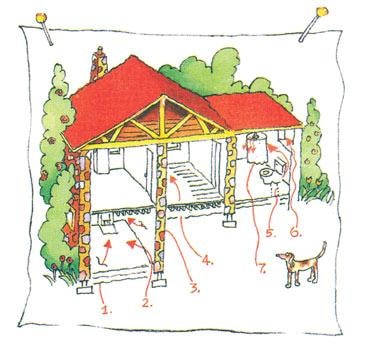
Nearly 1 out of every 15 homes in the U.S. is estimated to have elevated radon levels. Elevated levels of radon gas have been found in homes in Fairfield County Connecticut. Contact the state of Connecticut radon office for general information about radon in your area. While radon problems may be more common in some areas, any home may have a problem. The only way to know about your home is to test.
Radon can also be a problem in schools and workplaces. Ask your state radon office about radon problems in schools, daycare and childcare facilities, and workplaces in Fairfield County Connecticut.
EPA Map of Radon Zones — Connecticut
The purpose of this map is to assist National, State, and local organizations to target their resources and to implement radon-resistant building codes. This map is not intended to be used to determine if a home in a given zone should be tested for radon. Homes in Connecticut elevated levels of radon have been found in all three zones. All homes and Commercial real estate in Connecticut should be tested regardless of geographic location.
- All homes and buildings should test for radon in Connecticut regardless of geographic location or zone designation.
- There are many thousands of individual homes in Connecticut with elevated radon levels in Zone 2 and 3. Elevated levels can be found in Zone 2 and Zone 3 counties.
- All users of the map should carefully review the map documentation for information on within-county variations in radon potential and supplement the map with locally available information before making any decisions.
- The map is not to be used in lieu of testing during real estate transactions.
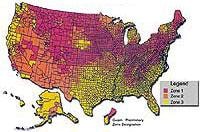
IMPORTANT: Consult the EPA Map of Radon Zones document (EPA-402-R-93-071) before using this map. This document contains information on radon potential variations within counties. EPA also recommends that this map be supplemented with any available local data in order to further understand and predict the radon potential of a specific area.
Currently Serving:
Fairfield County Connecticut — Greenwich, Stamford, New Canaan, Darien, Norwalk, Wilton, Weston, Westport, Fairfield, Easton, Stratford, Bridgeport, Redding, Newtown, Trumbull, Sandy Hook, Shelton, Danbury, Milford, Bethel, and Monroe CT
Ready to schedule your inspection?
Call us at 203-254-6463 or request a quote online.